A Tale of Two Cities: The Occult History of Philadelphia Part I
- Akhenaton
- Sep 4, 2017
- 13 min read

" As above, so below. As within, so without."
- Hermes Trismegistus (Thoth)
There are essentially two histories for the city of Philadelphia two tales if you will. Most are familiar with the more famous history of Philadelphia this is the one that attracts millions of tourist to the city each year on the ridiculous Duck Tours. This well known Philadelphia includes trips to Independence Hall where the Declaration of Independence was once signed in 1776. One must then visit the famous Liberty Bell and go for a walk, or even take a ride on a horse drawn buggy down the old cobblestone streets in Old City. A visit to Philadelphia may draw a person to the fairly new Constitutional Center, and aromas from the Reading Terminal Market encourage everyone to partake in the age old ritual of clogging arteries, as they forgivably devour a cheesesteak, or a soft and warm Philly pretzel which will of course be washed down with a cold flavorful Italian water ice. There is however another history of Philadelphia. A history that is shrouded in darkness, and looms under the radar. A history eclipsed by the more popular history of the city, but yet still exist just the same, if you know what to look for. This Occult History of Philadelphia is equally as interesting as the one just mentioned, and one could argue even more so. For the most part it is a story untold, and if when told the narrative is very disconnected, and incohesive. A buried forgotten history known only to academics, secret societies, and a few versed in the occult history of the city.
Philadelphia in many ways is the heart of the United States not the more popular Washington D.C. or New York. Indeed Philadelphia at one time was the nations first capital ten years before Washington D.C. was built. Out of all the early 13 colonies it was Philadelphia with its early democratic principals that laid the basic groundwork for what would best represent the future direction of the United States. Much is made about the state of Massachusetts and its colonies of Pilgrims and Puritans at both Mayflower and Massachusetts Bay Colony, but in truth Massachusetts would become a state known for extremism and religious intolerance horribly displayed by the events of the Salem Witch Trial that left 20 innocent people killed.

Jamestown, Virginia, does not fare well when discussing the beginnings of our nation. The colonists at Jamestown were undisciplined, and due to inadequate farming and lack of preparation, they soon faced starvation and resorted to cannibalism to survive. The treatment of Native Americans and the abduction of Pocahontas also tarnish Jamestown's reputation. In contrast, William Penn's Pennsylvania stands out among the other colonies. Pennsylvania, meaning "Penn's Woods," was land granted to him by the king of England to settle a debt owed to William's father. Penn's Quaker background led him to make treaties with Native Americans instead of engaging in warfare. Pennsylvania was unique, especially compared to Puritan Massachusetts, as it offered religious freedom to its settlers. Many believe that Penn's democratic outlook and religious tolerance may position him as a precursor to Freemasonry. Although William Penn would not have been a Freemason, as he lived before the first lodge dedicated to Freemasonry was founded in England, there is a notable obelisk dedicated to him at Penn Treaty Park in Philadelphia, likely erected in his honor because of what he represented.

Obelisk have a tendency to pop up over the graves of many prominent Freemasons of the past the most famous being the Washington Monument dedicated to George Washington, for it represents the smooth perfected man who came out of the rough ashlar, but who is now upright man resurrected to his living perpendicular. William Penn with his Quaker background that stressed equality along with his possibly freemasonic philosophy of religious tolerance would welcome all to his woods.

One of the groups that Penn welcomed was a group of Rosicrucian monks from Germany lead by their spiritual leader Johannes Kelpius. The Rosicrucians are very much like the Freemasons as they are both secret societies, and there seems to be a close connection between the two groups, as there is a masonic degree dedicated to them in Freemasonry as well, so it would not be a complete surprise at all for Penn to invite kindred spirits to his woods. Kelpius's society of religious monks settled in the wilderness of Fairmount Park near the Wissahickon Creek. There was much more to Kelpius clan than meets the eye. There were 40 monks in all and the number was chosen for a reason.

Philadelphia, Pennsylvania, is situated on the 40th Parallel, just like the ancient city of Philadelphia in Turkey mentioned in the Book of Revelations. The ancient church of Philadelphia is one of the churches favored by God in the Bible. It is commonly believed that William Penn chose the name Philadelphia because, when translated from Greek, it means "brotherly love." While this may be true, the fact that both Philadelphias—the one in Turkey and the one in Pennsylvania—are located on the 40th Parallel, along with Philadelphia's mention in the Bible, suggests a deeper, possibly spiritual or occult reason for Penn selecting Philadelphia as the name for his most significant city.

Johannes Kelpuis and his society of Rosicrucion monks would build a structure along the Wissahickon that would be 40-by-40 feet and with the use of a telescope they would use the structure as an observatory to look for signs in the movement of the stars. These were not the average monks, but more like hermetic priest blending the spiritual world with science. The fact that it was 40 monks in all living in a 40-by-40 foot structure is no coincidental at all. All that is left today from Kelpius's groups existence in Fairmount Park is a strange contested cave known today as the Hermit's Cave where it is believed Kelpius would go to study, meditate, and pray for Gods return. In the 1960s a Rosicrucian order erected a monument dedicated to Johannes Kelpius outside of the cave that is oblivious to most passing joggers that run through the park never realizing the early history of secret societies and occult mysticism that was once practiced in Penn's woods.
While on the subject of Fairmount Park, in and of itself, it has its very own occult history being that it was home to the indigenous people known as the Lenape Native American tribe.

Some believe that the Lenape would hold ceremonies at the very top of the mound that is today the location of the Philadelphia Museum of Art made famous by Sylvester Stallone's famous jog in his Rocky movie. Mound building was a vast culture made famous by the Native Americans who lived along the Mississippi, Ohio, and Missouri Rivers, but it also extended as far as the eastern part of the United States even reaching as far as Pennsylvania.

It is believed that Native Americans regarded mounds as sacred, using them as burial sites for their ancestors. Thomas Jefferson is renowned for constructing his home at Monticello atop a mound in Virginia and excavating the site, as mounds held significance in European culture as well. It would be intriguing if future archaeologists were to excavate the site beneath the Philadelphia Museum of Art to determine if there is concrete evidence of the Lenape using the site beyond folklore. Swedish colonists also viewed this Lenape Mound near the Delaware River as sacred, lighting fires on the mound to celebrate solstices and equinoxes. The Swedes referred to the mound as Fire-Mount, and today it is known as Fair-Mount or Fairmount Park, the most famous park in Philadelphia. Celebrations of solstices and equinoxes are ancient sun rituals practiced worldwide by diverse groups, from Egyptian priests to the Druids of the British Isles who constructed Stonehenge.

It is therefore interesting to mention that when Pope Francis came to the United States to visit this past year he made quick stops in New York and Washington D.C., but his most important visit was his Sunday services held in Philadelphia, as he sat on top of the old Fire-Mount. What makes the visit odd is the great respect the Pope showed the sixth largest city in the United States, for most people Philadelphia is dwarfed in importance by both the much larger New York and Washington D.C. which is the political center of the United States, but did Pope Francis know something about Philadelphia's spiritual and occult significance that most did not know? Or is this all coincidence?
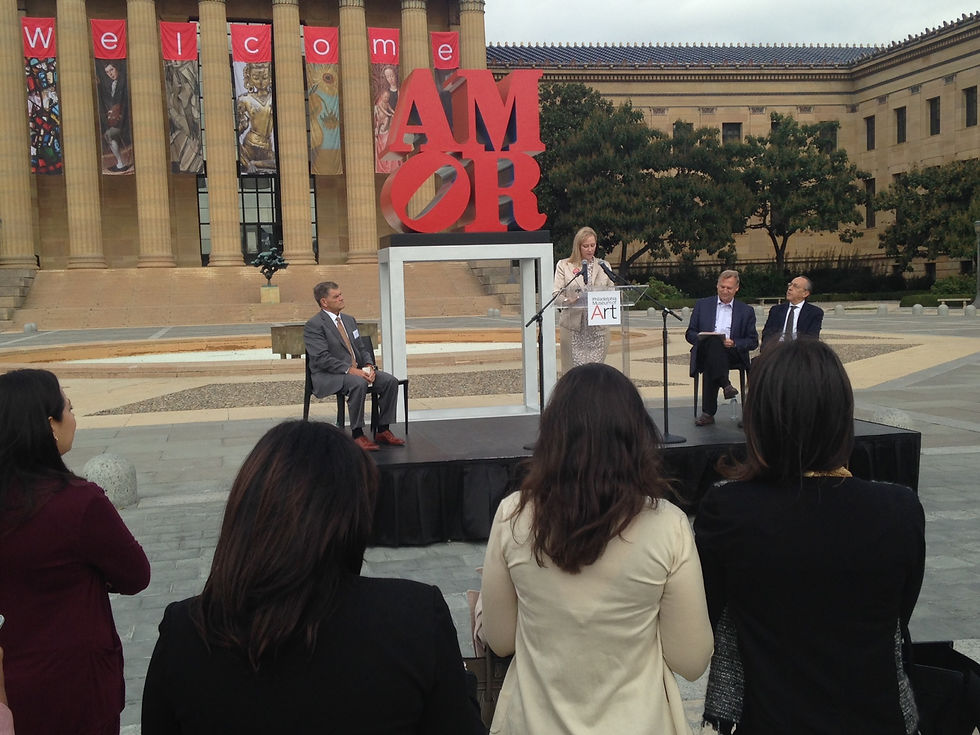
What is even stranger is that an AMOR sign was placed at the top of the Philadelphia Museum of Art just to greet the Pope. The official statement was that it was a way to welcome the Pope in his native language, amor translated out of Latin means love.

Students of the occult, as well as those members of secret societies probably laughed at the coincidence because AMOR, or AMORC is also the acronym for Ancient Mystical Order of the Rose Cross also known as Rosicrucian. Being that Pope Francis is a Jesuit he must surely be aware of the Rosicrucian monk Johannes Kelpius and his band of 40 men who settled in Penn's Woods on the 40th Parallel observing the stars waiting on the end of times.
Kelpius Cave and the Fire-Mount/Fairmount are not the only occult locations in Philadelphia; the city's street layout also has an esoteric history. William Penn appointed Thomas Holmes as the surveyor for Philadelphia. Independent historian Robert Bauval, in his book "Talisman" co-authored with Graham Hancock, reveals that Holmes's street design for Philadelphia was intended to be situated between the Delaware and Schuylkill rivers, similar to how ancient Babylon was positioned between the Tigris and Euphrates rivers. Holmes's design not only draws inspiration from Babylon with its rivers but also in the way the streets intersect, running North-South and East-West, which is said to resemble the ancient street layout of Babylon.
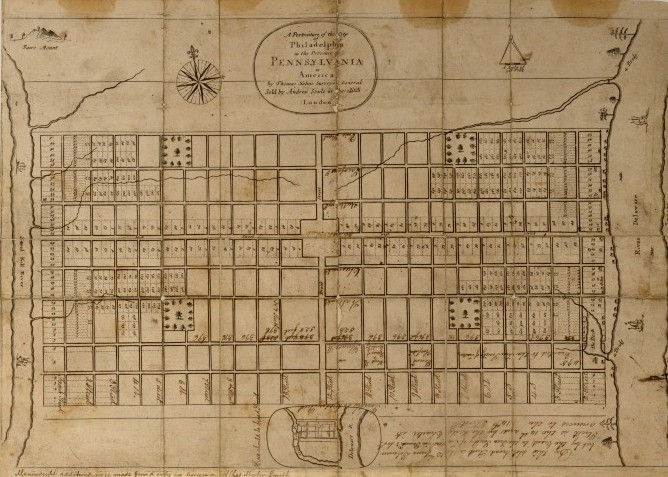
In fact many of the streets from the pagan civilizations of Babylon as well as Egypt follow this exact street design with the axis being in the middle of the city. In the Bible Babylon has a negative connotation because they held the Hebrews captive; however, for many masonic historians Freemasonry often uses a symbolic language that is not always literal. For the mason Babylon was a place of the first great builders that predated the builders of King Solomon's Temple.

Babylon was founded by Nimrod and it was from this civilization that we are said to get the architectural wonder known as the Tower of Babel that attempted to reach the Heavens before god was said to have knocked it down. It is interesting because in much the same way that Freemason's have a degree and rituals based on the Rosicrucians there are also masonic rituals based on Nimrod and Babylon.

Although I have not been able to confirm that, what is clear is a copy of his original map design, showing Philadelphia positioned between the Delaware and Schuylkill Rivers, much like ancient Babylon was located between the Tigris and Euphrates. If you examine closely above Thomas Holmes's street plan on the top left side, you can see the Fire-Mount/Fair-Mount, sacred to the Lenape tribe and the Swedes. On the top right side, there is a compass, which immediately caught my attention, as it is a prominent symbol in Freemasonry. This suggests that Holmes and Penn might have been members of the secret society. Just as William Penn is commemorated with the smooth ashlar at Penn Treaty Park, Thomas Holmes's grave features an obelisk. Holmes's name remains significant in the city, being linked to Holmesburg, Philadelphia, and Holmesburg Prison. The street design of Philadelphia cannot be discussed without mentioning the central axis that connects Market Street to Broad Street at Philadelphia's City Hall. City Hall is the tallest operational masonry building in the world. It was once the tallest building globally until surpassed by the Washington Monument and the Eiffel Tower, all three of which were ironically designed by Freemasons.
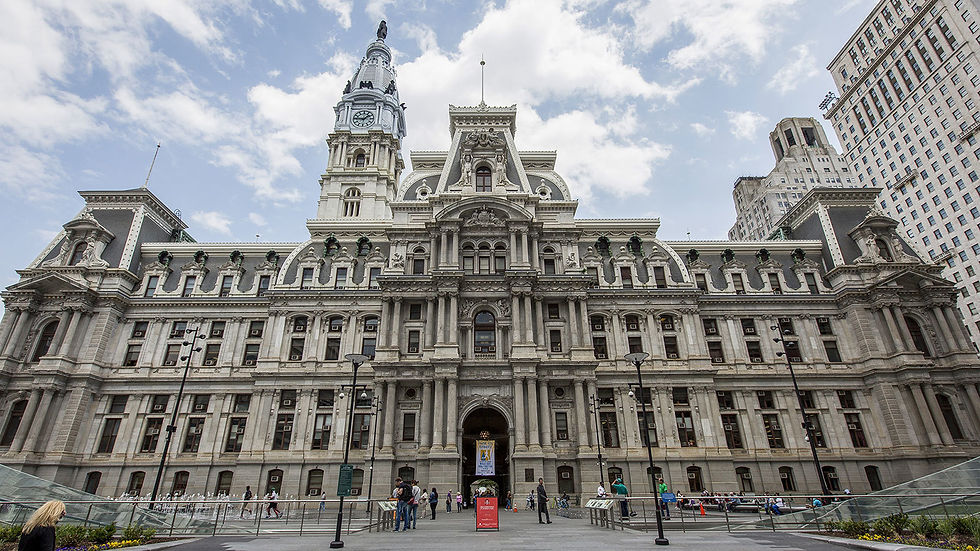
City Hall is an amazing structure designed by the Freemasonic architect from Scotland John McArthur. When you look at the detail on this building a few things stand out, for one you first realize that modern architects seem lazy compared to this piece of architecture. Today no one builds like this anymore, yes the buildings are much taller and the price tag is much bigger, but the attention paid to the most minute detail and craftsmanship is what is missing today.

Secondly, the building appears out of place, resembling something foreign, as if it should be situated in Scotland near Rosslyn Chapel or alongside the Gothic cathedrals of France. To further embellish its grandeur, the building is crowned with a 37-foot statue of William Penn. This statue holds the record as the tallest statue mounted on top of a building. However, what is most intriguing about City Hall is its incorporation of the Egyptian occult philosophy known as hermeticism. Hermeticism is a philosophy that gained prominence in Renaissance Europe. European philosophers studied the Hermetica, a collection of books containing the wisdom of the Egyptian sage Hermes Trismegistus, also known as the Egyptian God-Man Thoth.

It was later found that the Hermetica is not as ancient as once believed; however, scholars such as Francis Yates and Robert Bauval argue that the wisdom within the Hermetica dates back to the era of the Pharaohs. A central tenet of Hermetic philosophy is the phrase "as above so below." This reflects the Egyptian belief that Heaven or the afterlife existed in the stars or Duat, but if the Pharaoh ruled with justice and harmony, known as Maat, he could bring Heaven to Earth. Bauval demonstrated that this was not just theoretical but literal, as he revealed in his book The Orion Mystery. Bauval showed that the three pyramids at Giza, often thought to be tombs, were actually aligned with the three stars in Orion's belt. The Egyptians were literally attempting to mirror Heaven on Earth, as the phrase "as above so below" suggests.

The Egyptians not only aligned their pyramids to the sun, but also their temples. They did this not only to illuminate the structure but also to energize their civilization by aligning their micro world to the much larger macro universe, for example the Temple of Karnak is aligned to the winter solstice on December 25th.

This secret occult astro-architectural knowledge somehow persisted through the rise and fall of civilizations. This ancient occult hermeticism is embedded in some of the world's most renowned and significant structures, from government buildings to the Vatican, with the aim of harnessing the power of being aligned with the universe. The Vatican's old St. Peter's Basilica was aligned with the sun on the vernal equinox, and the Vatican's sister church in Turkey, the Hagia Sophia, like Karnak, is also aligned with the sun on the winter solstice. Government buildings in Washington D.C. are aligned with the constellation Virgo to symbolically give birth to the virgin democracy. On June 24th, the date of the summer solstice, the sun shines down France's most famous avenue, the Champs-Elysees, directing its rays through the Arc de Triomphe.


It is of course no accident that the Arc de Triomphe is at the center of twelve connecting streets an obvious symbolism for the journey the sun makes through the twelve constellations during the twelve months of the year, as the hermetic saying goes"as above so below."

What I find most interesting is how the church seemingly had no problem encoding this pagan philosophy into their architecture. France's most famous Gothic cathedral the Cathédrale Notre-Dame de Chartres dedicated to the Virgin Mary is aligned to the sun during summer solstice. The sun shines its light right through a window strangely enough dedicated to Apollo who we all know was a Greek sun god. The Greek god Apollo would later be identified with the Egyptian sun god Horus.


To the average person, this might appear quite sacrilegious unless those with the esoteric knowledge to build Chartres perceived connections and universal truths across various faiths. They did not seem to find this contradictory in the least. It's well recognized that the Black Madonna and child at Chartres strongly resemble the Egyptian mother and child, Isis and Horus. It appears that these hermetic builders were successfully integrating ancient ideas with new ones, while subtly acknowledging the source of their wisdom through solar alignments.

It is important to note that the Black Madonna at Chartres has recently been whitened under the pretext of restoration. Many in both the African-centered and occult communities view this as yet another attempt to disconnect people from our ancient history.

In conclusion, let's return to Philadelphia's City Hall. Similar to the Temple of Karnak, Washington D.C., St. Peter's Basilica, the Hagia Sophia, Chartres, and the Arc de Triomphe on the Champs-Elysees, City Hall was constructed using the same occult hermetic principles of "as above, so below." City Hall is aligned with the sun on October 13th, a date of great significance to the Freemasons. If you happen to be on Market Street on a clear, cloudless morning just before dawn, you will witness a sight that few are aware of: the sun rising above the horizon, its rays shining down Market Street through the arch that appears to support Philadelphia's central seat of government.

It's a far more exhilarating experience than watching a predictable eclipse. The excitement lies in witnessing something hidden from the uninitiated, echoing the old hermetic axiom "as above, so below." The statue of William Penn atop City Hall overlooks the intersection of Broad and Market Street, symbolizing how Penn's democratic vision aligns with universal laws. City Hall, designed by John McArthur, conceals another secret: the significance of October 13th for its solar alignment. Why was this date chosen? On October 13, 1307, King Philip IV of France, driven by jealousy and debt, ordered the arrest and subsequent torture and execution of the Knights Templar. This event is said to be the origin of the belief that Friday the 13th is unlucky. However, many Templars escaped to Scotland and Switzerland, eventually evolving into Freemasonry. Many Freemasons later journeyed to the New World, helping to establish American colonies. Through revolution, they founded the United States, the first modern democracy not governed by a monarch or religious authority, with Philadelphia as its first capital. Overshadowed by figures like Washington, Franklin, and Jefferson, William Penn remained in the background. Surprisingly, he is not buried in the United States but in a modest grave in England, having died penniless. Yet, he was the visionary who sowed the seeds of democracy in America at a time when despotic monarchs and religious intolerance prevailed. The new democracy faced its own contradictions, such as slavery and limited women's rights, but Penn's Philadelphia experiment laid the groundwork for future progress. When visiting Philadelphia, or if you reside there, take a hike along the Wissahickon to find a humble Hermit's Cave. Reflect on the Rocky Steps of the Philadelphia Museum of Art to consider if they're an ancient mound. If you're in Philadelphia on Friday, October 13th, at dawn, head to City Hall at Broad and Market to witness a remarkable sight.

Believe it or not, there are numerous lesser-known occult sites in Philadelphia and its surrounding areas that would overwhelm a single blog post. Therefore, I plan to feature these less-visited locations in The Occult History of Philadelphia Part II. I also want to provide a disclaimer about this article, particularly regarding the term "occult." The word "occult" often conjures images of the devil or thoughts of films like The Omen or The Exorcist. However, in reality, it's not as thrilling. The term "occult" simply means hidden, as in hidden Philadelphia. So, feel free to explore these sites without fearing possession, and instead, see it as an introduction to a fascinating, obscured chapter in Philadelphia's history.

Further Reading:
Allen M. Hornblum and George J. Holmes, Philadelphia City Hall, 2003, Arcadia Publishing.
Louis Charpentier, The Mysteries of Chartres Cathedral, 1975, Avon Books.
Graham Hancock and Robert Bauval, Talisman, 2004, Element.
Francis Yates, Giordano Bruno and the Hermetic Tradition, 1964, University of Chicago Press.
Robert Bauval, The Orion Mystery, 1994, Three River Press.
Robert Bauval, Chiara Hohenzollern, and Sandro Zicari, The Vatican Heresy, 2014, Bear & Company.
David Ovason, The Secret Architecture of our Nations Capital: The Masons and the Building of Washington D.C., 2002, Perennial.
Bob Brier, Cleopatra's Needles: The Lost Obelisk of Egypt, 2016, Bloomsbury Publishing.
Comments